
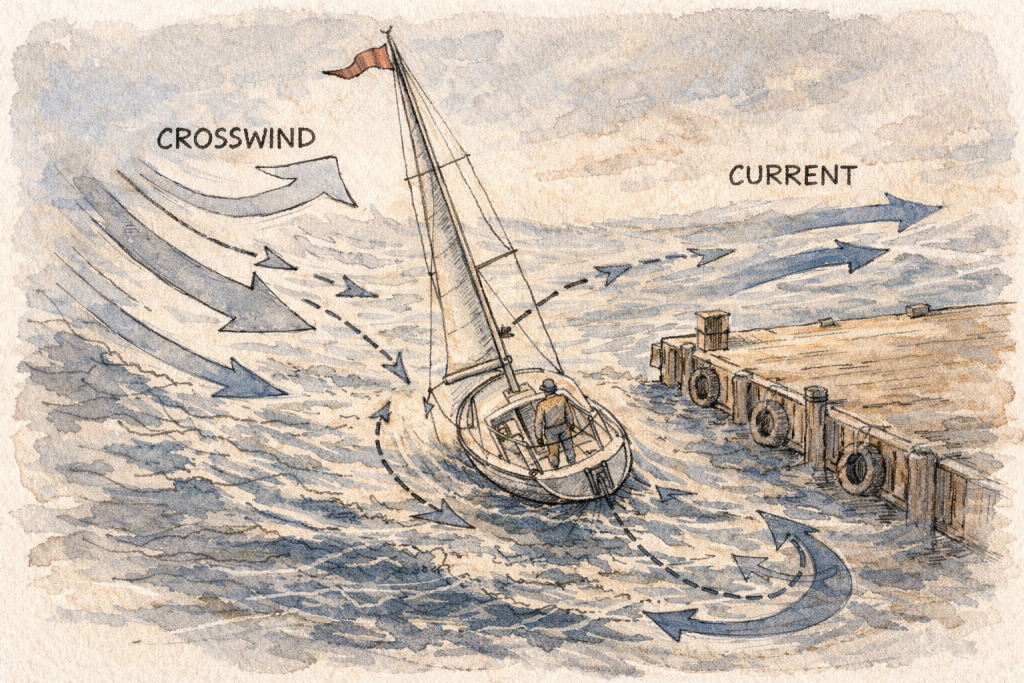
At cruising speed, the boat has momentum and the rudder has flow.
At docking speed, the wind and current become the dominant forces, and the rudder may not have enough authority to correct quickly.
What changes at slow speed
- Rudder effectiveness drops as water flow decreases.
- Gusts act like sudden sideways pushes with no warning.
- Current doesn’t care about your intentions—it moves you continuously.
Two practical habits
- Make corrections earlier than feels necessary
At low speed, the correction takes time to show up. - Use short controlled bursts instead of constant power
Constant low power often creates drift + uncertainty.
A brief burst gives you a clear response and buys time.
Log note
Most “I had no steering” moments were really “I had no water flow over the rudder.”
The solution is usually timing and flow, not brute force.
Follow-up Questions
Anyone can read this Q&A. If you have the same issue, leave details (boat length, conditions, setup).